
HISTORY OF MOUNT TAMBORA
Indonesia, a sprawling archipelago of 17,500 islands, is a nation adrift in the ocean. But the land has an equally strong —if not stronger— impact on Indonesia’s population. Sitting atop colliding plate boundaries, the country has been wracked by frequent earthquakes and volcanic eruptions.
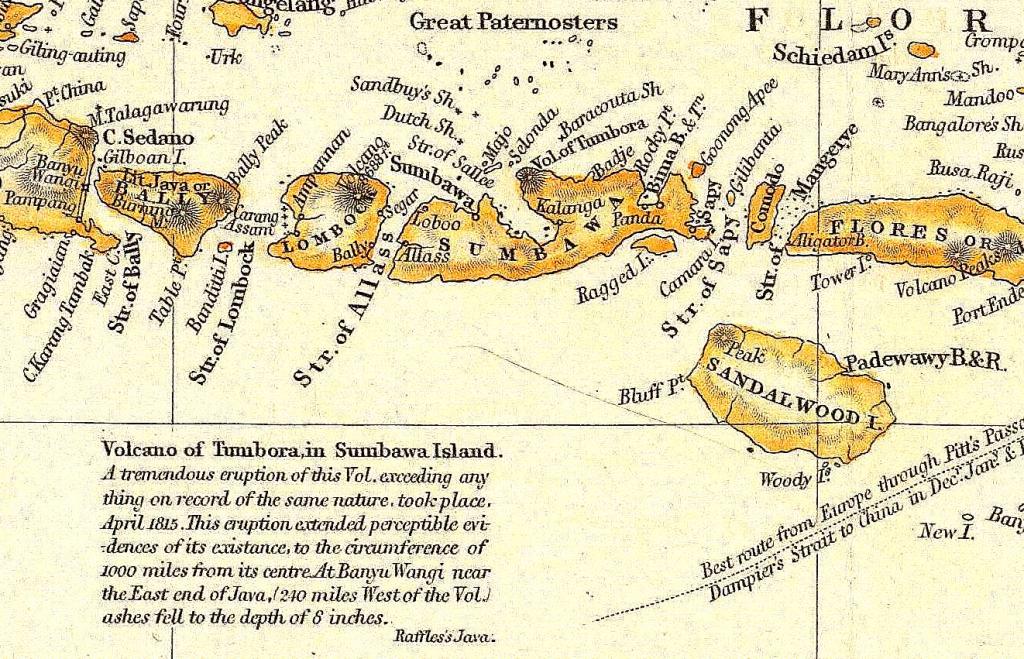
Sumbawa is the largest island in the West Nusa Tenggara province, at 15.400 km2, roughly the same size as Switzerland. From east to west the island stretches 280 km’s, while the distance from north to south varies from 15 to 90 km’s. The island’s population is around 1.000.000, 3 times less than neighboring Lombok, which is also 3 times smaller than Sumbawa. The entire island is characterized by a steep and rugged topography, dry rolling hills, deep valley gorges and the 2350mtr Tambora volcano as its centerpiece. Sumbawa is predominantly volcanic with a limited extent of uplifted limestone in some coastal areas. Sumbawa has a total of 56 islands, of which a dozen are inhabited; the largest is Moyo Island which is also made up entirely of limestone.
THE BIGGEST ERUPTION IN HISTORY
Sumbawa is a part of one of the most tectonically active regions in the world. In 1815, the dramatic explosion of the Tambora volcano found its way in the Guinness Book of Records as the biggest volcanic eruption in modern history. Its eruption was a catastrophe without equal in recorded history.
Before the eruption Mt. Tambora was a volcanic cone more than 4,000 meters high and 60 kilometers in diameter at sea level, densely blanketed in forest. The volcano had never erupted or been active before in living memory. Although the top of the mountain collapsed in 1815, what still stands today is unusual and provocative in its features.
The eruption of Mt. Tambora occurred quite unexpectedly. The consequences of this natural disaster were catastrophic and far-reaching, not only for the subsequent history of the Indonesian archipelago, but also for developments in the world at large.
Although almost everyone has heard of the eruption of Mt. Krakatau in 1883, many people have never heard of the eruption of Mt. Tambora. Yet, in the latter explosion much larger quantities of volcanic material were released and many more people were killed. The consequences of the eruption for Sumbawa were disastrous. There was pumice stone, lava and ash scattered all over the island; the average depth of the layer of ash covering the ground measured 50-60 centimeters, though closer to the volcano it reached more than 3 meters.
The falling pumice and masses of ash destroyed many homes. The kingdoms of Pekat and Tambora were wiped off the face of the earth, with none of their inhabitants, including their rajas (Abdul Gafur of Tambora and Muhamad of Pekat), surviving the cataclysm. Eventually 117,000 people in the region died, most of them from disease.
Neighboring Islands: The consequences of the volcanic eruption in Sumbawa were not restricted to this particular Island; other islands in the vicinity also experienced the effects. The islands of Bali and Lombok and South Sulawesi were particularly badly hit. Heavy ash falls following the eruption covered the nearby islands with a blanket of ash about 20-30 cm. thick. For a number of people these ash falls were directly fatal. Many were killed immediately, buried under collapsing buildings which caved in under the weight of the huge quantities of ash. The great majority, however, lost their lives as a result of the destruction of the crop. A serious famine in Bali and Lombok resulted soon after the eruption. This plunged the islands into an abyss of poverty and misery.
GLOBAL EFFECT
The consequences of the eruption were starkly evident in the area around Mt. Tambora and its neighboring islands but they were not confined there, for debris and/or chemicals shot up into the atmosphere affected the weather of the whole world, particularly Europe and North America. The summer of the year following 1815 was unusually rainy and cold; in fact, 1816 came to be known as the “year without a summer”. Although at the time no one suspected any connection with the volcanic eruption of the previous year, today this connection is widely recognized.
The summer of 1816 was exceptionally cold—an average of 1 to 2.5 degrees lower than normal—especially in the northeastern parts of the United States, in Canada and in Western Europe. The minimum daily temperatures in the northern hemisphere were extremely low. People around the globe suffered from malnutrition and many died from starvation. The exact numbers are not known.
THE KINGDOM OF TAMBORA
By about 1800 human settlements were established throughout the island of Sumbawa, all belonging to one or another of the six petty princedoms or sultanates existing here at the time: namely Sumbawa, Bima, Dompo, Sanggar, Pekat, and Tambora. These settlements were located mainly near rivers and teak (Tectona grandis) forests.
Before the year 1815 People made a living primarily by growing rice, mung and maize, and by selling coffee, beeswax, pepper, cotton, timber, honey, redwood, sandal wood, incense, red dye, and horses. The area was thought to be highly productive agriculturally.
At the time of the eruption, Tambora may have had up to 10,000 residents and been a small wealthy kingdom. The Tamborese were no easygoing people as can be seen from the wars of succession in this kingdom. They were known as brusque and short-tempered. Resident Tobias estimates, in 1801, that they “are surely the best and bravest nation on this coast”.
The last three rulers of the small Kingdom Tambora;
Abdul Rasyid Talul Arifin (1773-1800),
Muhammad Tajul Masahor (1800-1801)
Abdul Ja’far Daeng Mataram (1801-1815).
Their village was 4 miles inland to protect them from pirates, but its location left them vulnerable to the eruption. An entire kingdom of people was buried there. It may be a bit of hyperbole to speak of a kingdom, but what has been excavated is probably just the first of more villages to come.
ARCHAEOLOGICAL RESEARCH
On the evening of April 11, 1815, at approximately 7 PM, a surge from the eruption of Mount Tambora swept through the surrounding region, burying the area in a violent wave of pyroclastic flows. The eruption instantly devastated everything within a 7 to 10 km radius of the crater, killing anyone in its path. The initial surge struck Tambora village with such force that it toppled structures, displacing rubble up to 2 to 4 meters. The intense heat of the surge was sufficient to carbonize nearly everything it touched, turning wood, people, and other materials into charcoal. Victims likely perished where they stood, as superheated ash and sulfurous gas clouds raced ahead of the eruption, killing them almost instantly. Most of the buildings in the area, constructed from wood and bamboo, were especially vulnerable to the scorching heat of the pyroclastic flows and surges, which easily destroyed or consumed them.
In the 2004 excavation site, pumice deposits accumulated to such an extent that they likely caused roofs to collapse. These houses, abandoned but still intact when the surge struck, were later found to contain human remains—two skeletons—offering poignant evidence of the eruption’s deadly impact. Ongoing excavations have revealed a well-preserved house at a depth of 2 to 3 meters beneath layers of pyroclastic deposits. The original structure, including beams, roofing materials, and bamboo flooring, was identified, though all were severely charred due to the extreme heat. Other artifacts, such as Chinese porcelain, pottery, and copper bowls, were also discovered within the house, further illustrating the everyday life of the villagers before the disaster.
In 2008, another excavation unearthed a house on stilts, completely carbonized by the eruption’s forces. Near the house, the skeleton of an individual was found, positioned upward. This person had a ceremonial dagger (a Kris) and a copper tobacco box tied to his waist, along with a ceremonial spear at his side. In his hand, he held several rings inlaid with precious stones, and around his neck was a necklace with a large pendant, which was clearly a symbol of royal attire. A bracelet adorned his wrist. Nearby, numerous other artifacts, including ceramics, bottles, and coins, indicated that this individual was not of common status, but likely a person of higher social rank within the Kingdom of Tambora.
In 2009, further excavation uncovered another wooden house, also carbonized, aligned with the previously discovered structures. Outside this house, a skeleton was found. The victim appeared to have been struck by the collapse of the building, falling face down into the pumice and ash deposited by the eruption. The left hand was found beneath the head, seemingly in an instinctual effort to protect it from the fall, while the legs were covered in debris. Based on the size of the skeleton, it is believed to have been a male, approximately 1.85 meters tall. The collapsed house, a wooden structure with a grass roof built on stilts, contained several valuable artifacts, reinforcing the idea that this linear row of houses belonged not to ordinary villagers, but to individuals of higher status within the Tambora community.

 Visit Tambora